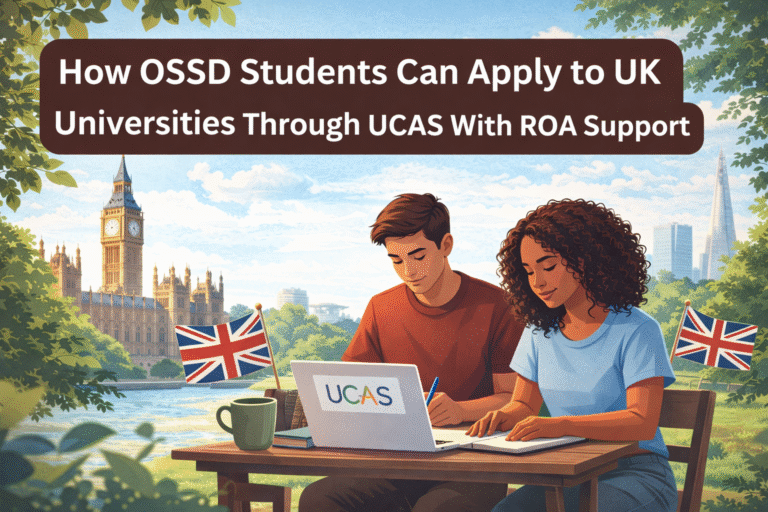
How OSSD Students Can Apply to UK Universities Through UCAS With ROA Support
For many students completing high school today, university planning is no longer limited to their home country. Students are increasingly exploring international universities, and the United Kingdom remains one of the most popular destinations for higher education.
Families often ask an important question: “Can OSSD students apply to UK universities?”
The answer is yes. Many universities in the UK accept students completing the Ontario Secondary School Diploma (OSSD).
Now, with access to the UCAS Adviser Portal, Royal Ontario Academy (ROA) can support students through the official UCAS application process used by universities across the United Kingdom. This support helps students confidently explore UK university applications while completing their OSSD.
What is UCAS and Why do UK Universities Use It?
When students apply to universities in the United Kingdom, they usually do not apply directly to each institution separately. Instead, they apply through a centralized system called UCAS (Universities and Colleges Admissions Service). UCAS allows students to submit one application that can be sent to multiple universities.
Through UCAS, students can:
- apply to several UK universities in a single application
- submit academic qualifications and school information
- complete a three-part personal statement explaining their motivation, academic preparation, and relevant experiences
- receive admission decisions from universities
Because almost all UK universities use UCAS, understanding how this system works is an important step for students planning to study in the United Kingdom.
Can OSSD Students Apply to UK Universities?
Yes. Students completing the Ontario Secondary School Diploma can apply to many UK universities.
Admissions decisions depend on several factors, including:
- completed high school courses
- predicted grades for ongoing courses
- English language requirements (if applicable)
- program-specific requirements
Many UK universities evaluate international applicants individually, so meeting the right academic requirements is important. This is where school guidance can make a difference.
How Students Apply to UK Universities Through UCAS
Applying to universities in the United Kingdom may seem complicated at first. However, the UCAS system organizes the entire process into a clear set of steps.
Students typically follow this process when applying to UK universities.
Step 1: Research UK universities and programs
Students start by exploring universities and choosing programs that match their academic interests. UCAS allows students to apply to up to five courses or universities in a single application.
Step 2: Create a UCAS application
Students then create a UCAS account and begin their application. This includes entering personal details, academic history, and course choices.
Step 3: Complete the three UCAS personal statement questions
For applications for 2026 entry onward, the UCAS personal statement is divided into three questions rather than one continuous essay:
-
Why do you want to study this course or subject?
-
How have your qualifications and studies helped you prepare for this course or subject?
-
What else have you done outside formal education to prepare, and why are these experiences useful?
Students have a total of 4,000 characters, including spaces, across all three answers. Each answer must contain at least 350 characters, but students may divide the remaining character count between the questions in whatever way best reflects their experience.
Universities review the three answers together, so students should avoid repeating the same information. Their responses should provide specific evidence of their motivation, academic preparation, relevant skills, extracurricular activities, work experience, volunteering, or other preparation for the course.
Step 4: Submit academic information
Students provide details about their current high school courses and qualifications. For students completing the Ontario Secondary School Diploma (OSSD), this includes their current and completed courses.
Step 5: School reference and predicted grades
Most UCAS applications require an official school reference and predicted grades. These help universities evaluate a student’s academic performance before final grades are released.
With access to the UCAS Adviser Portal, Royal Ontario Academy can support students in providing these required school components.
Step 6: Universities review applications
Once the application is submitted, universities review the information and may make offers based on predicted grades or other requirements.
Students can then track their application decisions directly through UCAS.
How ROA Supports Students Applying to UK Universities Through UCAS
Applying to universities in another country can feel confusing at first. Each country has different admission systems, timelines, and requirements. With access to the UCAS Adviser Portal, Royal Ontario Academy can help guide students through the process.
Support typically includes:
Understanding UCAS timelines
Different programs have different application deadlines. Competitive programs such as medicine or law often have earlier deadlines.
ROA helps students understand these timelines so they can prepare their applications early.
Preparing the UCAS application
A UCAS application includes several important components:
- academic qualifications
- personal statement
- course choices
- school reference
Students often benefit from guidance when preparing these materials.
Providing references and predicted grades
Many UK universities require predicted grades for courses that students are still completing. Schools may also submit an official reference describing the student’s academic ability and learning progress.
Through the UCAS Adviser Portal, ROA can support these school-provided components of the application.
Why Many OSSD Students Consider UK Universities?
The United Kingdom is home to many globally recognized universities. For students looking for international education opportunities, studying in the UK offers several advantages.
Students often consider UK universities because they offer:
- internationally respected degrees
- specialized undergraduate programs
- shorter program durations compared with some countries
- diverse academic communities
For students completing the OSSD, applying to UK universities can open new academic opportunities.
Exploring Global University Opportunities With Guidance
Students today are preparing for a global future. Many explore universities not only in Canada, but also in the United Kingdom, the United States, and other countries. By supporting the UCAS application process, Royal Ontario Academy helps students understand how to apply to UK universities and prepare the required documentation. This guidance can make the process much easier for families who are unfamiliar with the UK admissions system.
Applying to universities in another country can feel complex, especially when families are unfamiliar with the admissions system.
By supporting the UCAS application process, Royal Ontario Academy helps students understand the steps involved in applying to UK universities from Canada. With guidance on timelines, application preparation, and school documentation, students completing the Ontario Secondary School Diploma can confidently explore international university opportunities.
Frequently Asked Questions About Applying to UK Universities Through UCAS
1. Can Canadian high school students apply to UK universities?
Yes. Many UK universities accept international students who complete recognized high school diplomas such as the Ontario Secondary School Diploma (OSSD).
2. What is the UCAS application process?
Students submit their academic information, course choices, school reference, and answers to the three UCAS personal statement questions through the UCAS platform.
3. Do students need predicted grades for UCAS applications?
Many universities request predicted grades for courses that students are currently completing. These grades help universities estimate the student’s final academic results.
4. How many universities can students apply to through UCAS?
Students can typically apply to up to five universities or programs through a single UCAS application.
5. Do schools need to submit references for UCAS applications?
Yes. Most UCAS applications include a school reference, which provides universities with insight into the student’s academic performance and readiness for university study.
6. Which UK universities accept OSSD students?
Many universities in the United Kingdom accept students who have completed the Ontario Secondary School Diploma (OSSD). Examples include the University of Manchester, University of Birmingham, University of Leeds, University of Nottingham, University of Warwick, and King’s College London. Admission requirements vary by university and program, so students should always check the specific entry requirements listed by each institution.
7. What are the three UCAS personal statement questions?
For applications for 2026 entry onward, students answer three questions about why they want to study their chosen subject, how their qualifications have prepared them, and what they have done outside formal education to prepare. Students have a combined limit of 4,000 characters, including spaces, across all three answers.