Grade 11 Functions and Applications MCF3M | OSSD Online School | royalontarioacademy.com
Curriculum Coordinator and Learning Strategist
Dr. Karen McCloskey
MA, PhD, QM Quality Matters
MCF3M
Grade 11
Open

Functions and Applications

Find additional course details below, including delivery format, course availability, course duration, prerequisite, tuition fee, hardware/software requirements, etc.

MCF3M
Grade 11
Open

Functions and Applications

Find additional course details below, including delivery format, course availability, course duration, prerequisite, tuition fee, hardware/software requirements, etc.

Course Code

MCF3M

Course Name

Functions and Applications

Grade

Grade 11

Course Type

Open

Format

Asynchronous Delivery

Prerequisite

None

Tuition Fee

$500.00

Course Duration

At Your Own Pace (4 weeks to 12 months)

Credit Value

1.0

Availability

Start Anytime

Course Reviser/Developer

Dr. Karen McCloskey

Latest Revision Date

September 2026
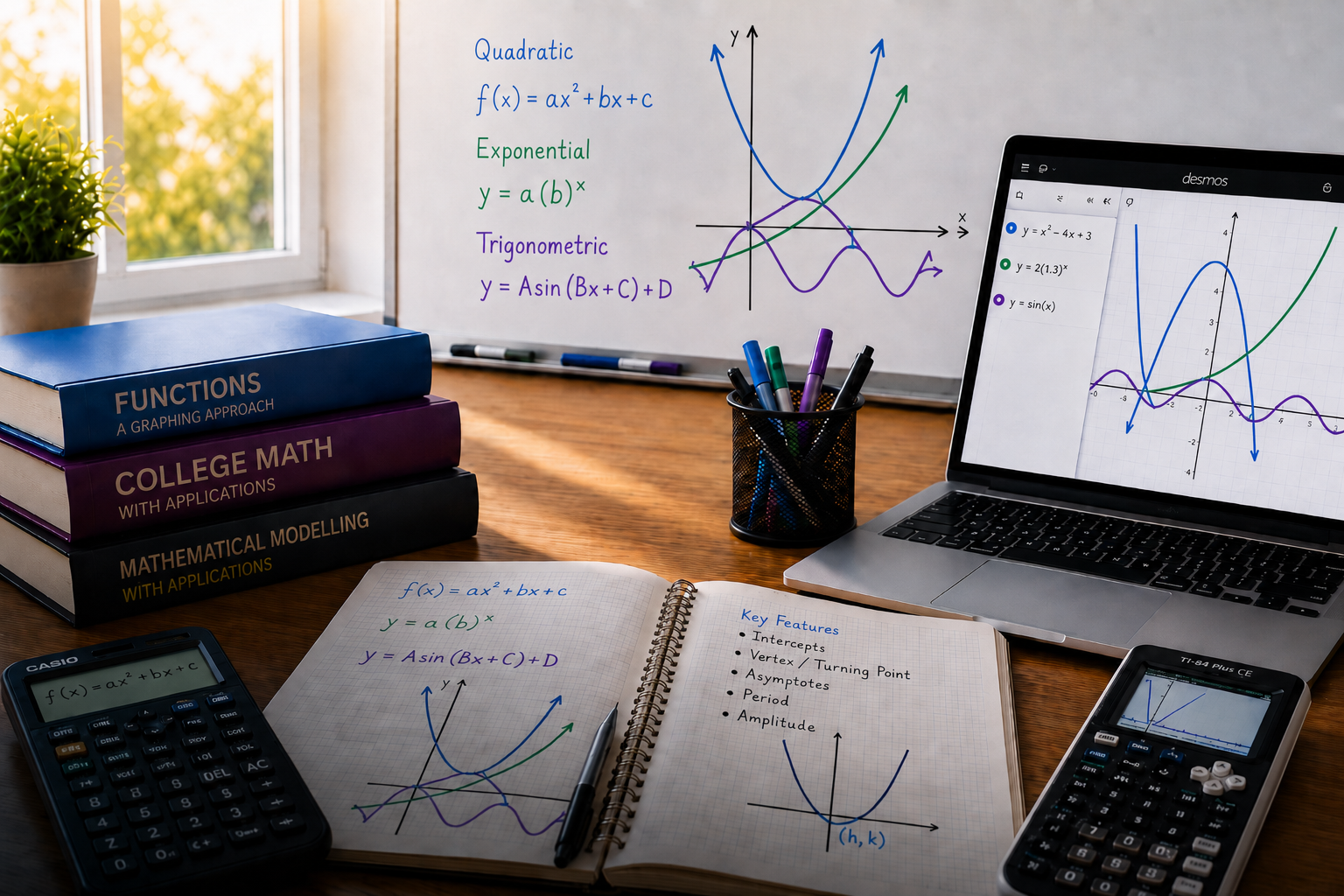
This course introduces students to the mathematical study of functions and their applications. Students will investigate quadratic, exponential, and trigonometric functions through algebraic, graphical, numerical, and real-world contexts. They will develop skills in solving equations, interpreting graphs, modelling relationships, and applying mathematical reasoning to situations involving motion, growth, finance, and periodic phenomena. Throughout the course, students will use tools such as Desmos and a scientific calculator to explore and verify mathematical ideas. Outlined below is a description of each unit, including what students will learn and the recommended hours for completion.
Outlined below is a description of each unit, including what students will learn and the recommended hours for completion.
Unit Title & Description
Time Allocated
Unit 1: Quadratic Functions

Students explore quadratic functions as a powerful tool for modelling real-world situations. They begin by expanding and factoring algebraic expressions, then solve quadratic equations using different strategies, including factoring, completing the square, and the quadratic formula. Students graph parabolas, identify key features, convert between different forms of quadratic equations, and apply their learning to problems such as projectile motion and revenue maximization.
35 Hours
Unit 2: Exponential Functions

Students investigate exponential functions, where the variable appears in the exponent. They review exponent laws and rational exponents, then graph exponential functions and identify their key properties, including growth, decay, intercepts, and asymptotes. Students apply exponential functions to practical contexts such as compound interest, present value, future value, annuities, and other growth or decay situations.
30 Hours
Unit 3: Trigonometric Functions

Students study trigonometric functions as tools for solving problems involving angles, triangles, and repeating patterns. They apply the sine law and cosine law to solve acute triangles, explore periodic functions and the sine curve, and use transformations to model real-world phenomena such as tides, Ferris wheels, and seasonal daylight. All angles are measured in degrees throughout this unit.
30 Hours

Final Exam/Culminating Task

Culminating Evaluation

Students review and consolidate learning from all three units as they prepare for the final assessments. They complete a culminating task and a final exam.
15 Hours
Total Hours
110 Hours
  • Leadership rotations & peer coaching: Students plan warm-ups and lead cool-downs, including inclusive adaptations.
  • Video analysis & performance logs: Focuses on movement phases, setting SMART goals, and monitoring progress.
  • Outdoor & community-based activity blocks: Involves learning about trail use, facility etiquette, and safety planning.
  • Scenario-based safety learning: Covers topics such as Emergency Action Plans (EAPs), concussion protocols, de-escalation, and help-seeking strategies.
  • Inquiry projects in Healthy Living: Projects related to food systems, media literacy, and anti-stigma initiatives.
  • Universal Design & differentiated tasks: Provides students with a choice of activity pathways and multiple product options.
Our approach to assessment and evaluation is grounded in the principles outlined in the Ontario Ministry of Education’s Growing Success document.

Key Principles

  • Fairness, Transparency, Equity: Clear success criteria; varied demonstrations of learning (performance, design, written/visual artifacts).
  • Support for All Students: Inclusive rehearsal and performance practices for students with special education needs, English language learners, and Indigenous learners.
  • Curriculum Alignment: All assessments anchor to A–C Drama strands and roles across theatre (performer, designer/technician, director, dramaturg).
  • Clear Communication: Criteria shared up front and revisited at scene pitches, design checkpoints, and rehearsal notes.
  • Ongoing & Varied: Observation, conversation, and product (e.g., in-role work, scene runs, design/tech labs, cue sheets, notes).
  • Descriptive Feedback: Timely, specific, strengths/next steps tied to the creative/critical analysis processes.
  • Student Self-Assessment: Rehearsal journals, director’s notes, design reflections, peer feedback logs, and post-show talkbacks.
At Royal Ontario Academy, we believe that all OSSD students can benefit from a more accommodating online learning experience Accommodations allow for increased access to the course, without any changes to the knowledge and skills the student is expected to demonstrate.

An Individual Education Plan (IEP)is a personalized document that outlines a student’s learning needs, as well as the accommodations or services they require to succeed in their courses. At Royal Ontario Academy, our flexible online learning environment already addresses many common accommodation needs, but if a student requires additional support, our Principal is ready to help you!

Students with Existing IEP: If a student has an existing IEP from another elementary or secondary school, Royal Ontario Academy can implement the listed accommodations, provided they are applicable within our online learning environment. To do so, a copy of the student’s IEP must be submitted to our Principal for review.
Students Without IEP: If a student requires accommodations but does not currently have an IEP, our Principal will work with the student to assess their learning needs and develop a path forward. In this case, students will need to submit supporting documentation to help determine the appropriate accommodations.
English Language Learners:– English Language Learners: Students who enroll at Royal Ontario Academy can provide information about their English language proficiency during the registration process. This information helps our teachers and Principal to tailor their teaching strategies and implement accommodations that support English language learners effectively.

For students and parents wishing to submit IEP documentation or request accommodations, please contact our Principal at info@royalontarioacademy.com

General Resources Students Should Have Access To

Course Pricing

$500

/ 1 course

$850

 / 2 courses

$1200

 / 3 courses

Start your learning journey with us.

Please enable JavaScript in your browser to complete this form.

Related Courses

Drama
ADA3M
Grade 11
Forces of Nature: Physical Processes and Disasters
CGF3M
Grade 11
The Individual and the Economy
CIE3M
Grade 11

Contact Us

Have questions or need more information? Our team is here to help. Contact us today to learn more about our programs, services, and how Royal Ontario Academy can help you achieve your academic goals.

  • Email: info@royalontarioacademy.com
  • Phone: 647-205-3788
  • Hours: Monday to Friday, 9AM – 4PM (EST)
  • Address: Virtual, Everywhere and 121 Brunel Rd, Mississauga, Ontario, Canada L4Z 3E9